
Walk a fire inspector or hospitality brand auditor into a guest room and a practical question arises: if mains power fails in the middle of the night and corridor smoke thickens, how does a guest navigate from the bed to the room exit? Outside mainland China, most building codes regulate fixed emergency luminaires rather than universally mandating handheld room torches, so guest-room torch demand is driven by international hotel brand standards, property insurers, and building fire risk assessments.
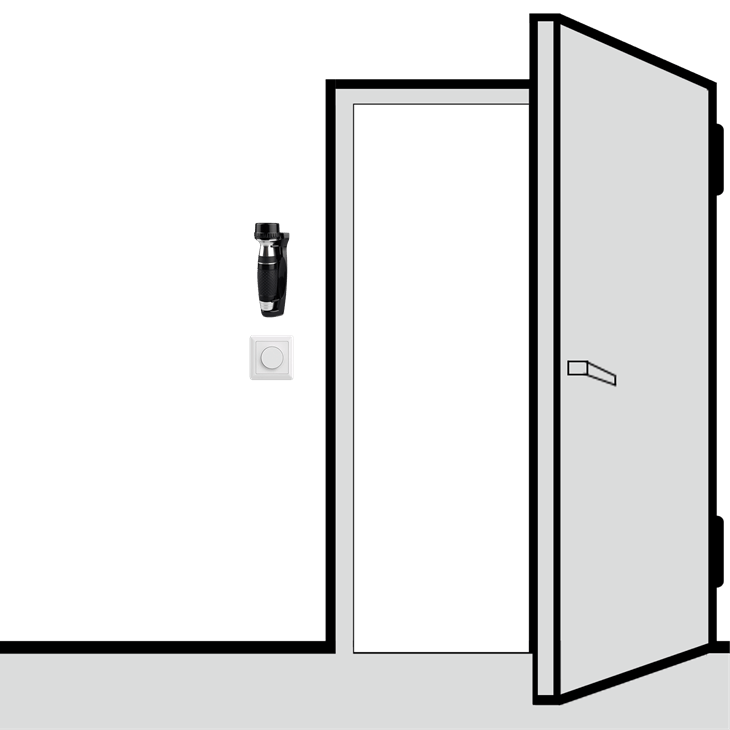
Fixed Emergency Lighting vs. Door-Side Guest-Room Torches
Fixed emergency lighting illuminates public corridors, exit signs, and stairwells from ceiling or high-wall luminaires connected to central batteries or integral emergency packs. A wall-mounted guest-room torch provides an independent portable light anchored right beside the entrance door inside each bedroom.
Because the two serve distinct roles, a handheld guest-room torch never replaces code-required fixed luminaires. Instead, hotels fit door-side torches to light inside the bedroom, illuminate enclosed bathrooms, and shine below ceiling smoke layers when guests crouch during evacuation.
International Fire Codes vs. China Standards
In North America, Europe, the UK, and the Gulf, fire codes primarily govern fixed building emergency lighting, whereas China explicitly specifies handheld guest-room torches in national fire-safety management standards:
| Jurisdiction / Standard | Scope & Fixed Lighting Rule | Handheld Guest-Room Torch Context |
|---|---|---|
| United States / North America — NFPA 101 (§7.9) | Life Safety Code requires fixed egress illumination along corridors, lobbies, and stairways for a minimum of 90 minutes. | Not universally mandated by NFPA 101; specified through hotel brand OS&E standards and insurer risk guidance. |
| Europe & UK — EN 1838 / BS 5266 | Set lighting design, illuminance, and duration standards for fixed emergency lighting installations. | Govern fixed building systems rather than portable bedroom torches. |
| England & Wales — UK Fire Safety Order 2005 | Requires the responsible person to maintain a fire risk assessment. (Note: Home Office guidance for small paying guest accommodation references power-failure auto-illuminating rechargeable torches; verify bracket-lift vs. mains-sensing specifications before ordering.) | A property risk assessment or brand standard may specify bedside/door-side guest torches. Neither VOFU-02 nor VOFU-01 switches on automatically on mains failure; both switch on when lifted off the bracket. |
| UAE — UAE Fire & Life Safety Code (Ch. 6) | Mandates 3 hours of Civil Defence approved fixed emergency lighting inside hotel rooms and suites. | Handheld room torches are not a Civil Defence listed luminaire category; used as a supplementary brand or safety item. |
| China (effective until 31 Mar 2027) — GB/T 40248-2021 (Clauses 8.2.1 & 8.2.2) | Front desk/lobby equipped with torches; high-rise hotel rooms shall equip and other hotels should equip torches in a conspicuous position with ≥30 min effective operating time. | Active until 31 March 2027; ≥30 min is referenced as a clear benchmark in that edition. |
| China (effective 1 Apr 2027) — Mandatory GB 40248-2026 (Clause 7.4.1) | Published 28 Sep 2026; upgrades to mandatory national standard requiring torches, respirators, and usage instructions at hotel front desks and inside guest rooms in conspicuous positions or clearly marked. | Mandatory across hotels in mainland China from 1 April 2027 (note: the 2026 text omits the earlier 30-minute time clause). |
For international export projects, VOFU-02 (3 × AAA dry cells) and VOFU-01 (110–240 V wired charging bracket) each deliver approximately 6 hours of continuous runtime under factory 25 °C testing.
Why Loose Torches in Bedside Drawers Fail Audits and Emergencies
Keeping an ordinary flashlight inside a bedside drawer or wardrobe undermines evacuation readiness and fails conspicuous-placement checks:
- Delayed reaction in darkness: Guests wake disoriented and head instinctively toward the room exit door, not back into drawers.
- Missing or dead units go unnoticed: Loose torches roll behind furniture, are accidentally packed into guest luggage, or sit with exhausted batteries.
- Inspection findings: Safety auditors expect fixed, visible placement, clear usage prompts, and reliable illumination the moment a guest reaches the unit.
Core Requirements for a Hospitality Wall-Mounted Torch
- Conspicuous door-side mounting: Screw-mounted beside the entrance door, paired with a fluorescent alert sticker (VOFU-02) or clear reminder label (VOFU-01).
- Zero-guesswork lift activation: Illuminates immediately when lifted off its wall bracket and extinguishes only when returned, encouraging staff and guests to return every unit properly.
- Predictable battery servicing: Runs on globally available 3 × AAA dry cells replaced every 3 months (VOFU-02) or a 110–240 V auto-cutoff charging dock with 3 × AA Ni-MH cells replaced every 1 year (VOFU-01).
Next step: compare VOFU-02 vs. VOFU-01, review the installation and inspection SOP, or read our 20-question buyer FAQ.